Issued: 9 February
5 mins read
Australia has a solid international reputation when it comes to our wildlife – and whether they strike fear or curiosity (or a little bit of both) into your heart, the southern cassowary is one fascinating Queensland icon that deserves your attention. Listed as Endangered, this rare and elusive bird has become something of an unofficial mascot for our northern regions – but how much do you actually know about the southern cassowary?
From its intriguing behaviours to the conservation efforts aimed at securing its future, here are 10 facts about the southern cassowary that’ll have you seeing this incredible creature in a whole new light.
1. The world’s most dangerous bird
Don’t let the title fool you – southern cassowaries are not typically aggressive unless provoked or cornered. That being said, they have the power to do real damage under rare circumstances – their dagger-shaped claws can deliver powerful kicks strong enough to break bones!
2. They are skilled rainforest gardeners
Ever heard of poo-cycling? Cassowaries are experts at it, playing a vital ecological role as rainforest gardeners. The southern cassowary diet includes a wide range of fruits and seeds that they disperse through their droppings, which helps regenerate their forest habitat. Some seeds even need their digestive system to germinate properly.
3. Endangered and elusive
Spotting a southern cassowary in the wild is a rarity, as these creatures are notoriously secretive. They are solitary creatures and prefer to live in their own home ranges, which are between 0.52 and 2.35 square kilometres. Female territories often overlap with several males’ territories.
They are classified as Endangered due to habitat loss, fragmentation, vehicle strikes, and predation by introduced species like dogs and pigs.
4. Ladies living large
Female southern cassowaries are larger than their male counterparts, reaching heights of up to two metres and weighing up to 76 kilograms. This imposing mass makes them one of the heaviest bird species in the world, alongside other (hefty) feathered friends like the ostrich and the emu.

5. Creature features
Southern cassowaries have a very distinct aesthetic, complete with a range of cool accessories – it makes them look positively prehistoric! They are easily recognisable by their vivid blue neck, long drooping red wattles, coarse black hair-like feathers, and their prominent "helmet" or casque, which may act as a thermo-regulator to cool off in high heat and humidity, or help to amplify low-frequency calls in dense rainforest. It has a honeycomb-like structure inside to increase surface area, possibly for regulating temperature and sound.
6. Dinosaur throwback
If you think cassowaries wouldn’t look out of place in Jurassic Park, you’re not too far from the truth. It’s believed these ancient birds began to evolve about 60 million years ago and share some characteristics with dinosaurs, including their three-taloned feet and respiratory systems.
7. First Nations significance
Southern cassowaries are deeply important to Queensland's First Nations people. The cassowary is known by different names across traditional territories, such as goondoi (Djiru Country), gumbugan (Mamu Country), kutini (Kuuku Ya'u Country), and wadthuuny (Gudang Yadhaykenu Country). The southern cassowary appears in traditional stories, ceremonies, and dances – its role in seed dispersal signifies an ongoing supply of fresh fruit from new trees.

8. They are #1 dads
The mating habits of the southern cassowary are a little unconventional – they don’t subscribe to traditional gender roles. In these communities, the father generally takes on child-rearing duties. After laying 3–5 large olive-green eggs, the female leaves and the male takes over, incubating the eggs for about 50 days and protecting the chicks until they are independent.
9. Not a picky eater
True to their role as rainforest gardeners, southern cassowaries are something of a natural compost system. They consume fallen fruits, fungi, snails, insects, and even small dead animals. Amazingly, their digestive system can handle seeds from up to 238 plant species, including fruits that are toxic to humans.
10. No-fly list
As well as being large in size and possessing powerful legs, southern cassowaries are flightless because their wing bones are small and underdeveloped. Instead of flight, their physical build is adapted for navigating dense rainforests – strong legs for running and jumping, and their streamlined body and feathers, with a relatively small and narrow head to help them push through thick vegetation.
What’s being done to protect the southern cassowary?
Efforts to protect the endangered southern cassowary are as unique and dynamic as the bird itself. A key focus is on protecting and restoring its rainforest habitat, which has been heavily impacted by land clearing and urbanisation.
More than 89% of their critical habitat in the Wet Tropics region is now protected, and organisations such as the Wet Tropics Management Authority and Terrain NRM are actively working to maintain and enhance these areas. New biodiversity credit schemes, like Cassowary Credits, encourage landholders to protect and regenerate vital rainforest areas, ensuring connectivity for cassowaries as they roam and spread seeds.
Queensland Government initiatives are also driving cutting-edge research to monitor and protect cassowary populations. This includes extracting DNA from cassowary scat and feathers to deepen our understanding of their movements and population dynamics, and expanding on historic satellite tracking studies with prospective projects for the near future. This work is often in partnerships with universities and various other researchers.
Facilities like the Garners Beach Cassowary Rehabilitation Centre and the Atherton Tablelands Cassowary Facility at Lake Barrine are playing an essential role. These purpose-built centres rescue, rehabilitate, and release injured or orphaned cassowaries, often in collaboration with local conservation groups.
How you can help the southern cassowary
Like all conservation efforts, your individual actions can go a long way in helping the iconic southern cassowary thrive and survive. Here are a handful of easy things you can do for southern cassowary conservation:
- Follow all Be "cass-o-wary" advice: If you encounter a cassowary in the wild, keep a safe distance and never approach it or its chicks. Back away slowly if the bird moves towards you, putting a barrier (like a tree or bag) between you and the bird if needed.
- Avoid feeding cassowaries: Feeding cassowaries is illegal and dangerous – it encourages aggressive behaviour and draws them closer to human areas, increasing their risk of vehicle strikes or attacks. Fines are applicable for cassowary feeding offences.
- Dispose of food scraps responsibly: Ensure bins and composts are secure to avoid attracting cassowaries to urban areas.
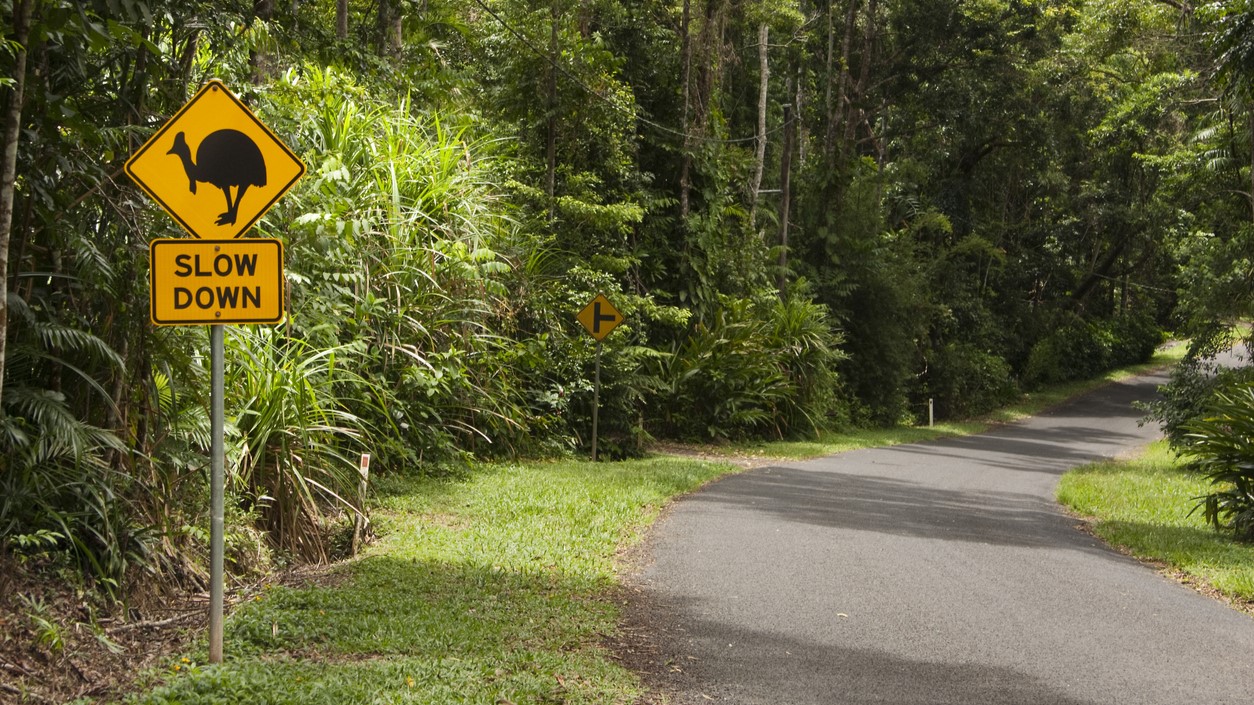
- Drive carefully in cassowary territory: Slow down and keep an eye out, especially in areas with “cassowary crossing” signs. If you see one on the road, don’t stop abruptly to take a closer look – this could cause accidents or stress the bird.
- Keep pets under control: Dogs can attack cassowaries, so ensure they are always kept on a leash or securely fenced in.
- Report sightings: Help rangers and researchers track cassowary movements by reporting sightings via the QWildlife app, or calling 1300 130 372 for urgent incident response, such as for road strikes. This data supports important conservation efforts, now and for the future.
This blog has been fact-checked by Jeff Lewis (Technical Officer), Alex Diczbalis (Senior Wildlife Ranger), and Georgia Parsons (Wildlife Ranger) from the Department of the Environment, Tourism, Science and Innovation. They are southern cassowary subject matter experts with a range of technical and practical knowledge, working within the department's Wildlife and Threatened Species Operations unit.
Newsletter
Get involved and stay informed with our handpicked environmental news, tips, and stories sent directly to your inbox.