Issued: 24 August 2025
8 min read
When it comes to adorable Australian fauna, few species are as beloved as the northern hairy-nosed wombat (NHW) - but these marsupials are also among the world's most critically endangered mammals. A vital element of supporting the northern hairy-nosed wombats is ensuring populations have capacity and the right habitat to grow.
Over the years, two additional protected sites have been established to help bolster the last remaining natural population of NHWs at Epping Forest National Park (Scientific) – these are naturally suitable sites that have been fitted out with a few extra features to help get the wombats back on track. One of these locations is Powrunna State Forest, which welcomed its first new hairy-nosed residents in May 2024. Fast-forward to mid-2025, and another successful round of translocations has seen even more wombats settling in.
Want to know how nature and recovery efforts combine for northern hairy-nosed wombat survival? Read on …
How it started
To understand the translocation project, knowing about the broader suite of actions for NHW conservation in Queensland is important.
It all starts with the Epping Forest National Park (Scientific), home to most of the world’s northern hairy-nosed wombats. By the early 1980s, the park housed the last remaining population of northern hairy-nosed wombats in Australia, with only ~35 individuals – this was the catalyst for intensive protection, research, and recovery efforts. These days, the population is estimated to be around 400 wombats – a much healthier-looking result.
The Richard Underwood Nature Refuge, managed by the Australian Wildlife Conservancy, is another critical site for northern hairy-nosed wombat conservation. The refuge protects 130 hectares of eucalypt woodland in southern Queensland – as well as around 18 wombats.

Dig it – northern hairy-nosed wombats need a specific soil density to build their deep burrows.
What is the Powrunna State Forest translocation project?
Powrunna State Forest in southern Queensland is a crucial third site for northern hairy-nosed wombat conservation. It provides an additional secure location for the species, helping to increase their population and improve their long-term survival.
The 2,800-hectare site lies within the historical distribution of the species, and its soil and vegetation type are a suitable match for the wombats. After some on-ground works to help give the wombats their best chance to thrive, Powrunna State Forest was ready to receive its first new tenants in 2024. By mid-2025, four successful translocations had already taken place.
The ultimate aim is to establish a thriving third population of at least 60 wombats by 2026.
Finding a new site
So, what sort of environment do northern hairy-nosed wombats need to make a suitable home for themselves? A lot of it lies in the dirt! These subterranean sweethearts dig quite vast burrows – just under half a metre wide and up to 3.5 metres in depth – often with multiple entrances. The soil composition to keep these large burrows structurally sound is surprisingly specific – it also needs to be to a depth of at least 2.5 to 4 metres. A suitable site also needs to be large enough to support at least 250 wombats. After many years of searching, Powrunna State Forest was deemed to have the right stuff to accommodate robust burrows and a healthy population of wombats.

A helping hand - specialists dig starter burrows for the wombats to move into
On the move – preparing for translocation
It takes a lot of teamwork to get a site prepped for new tenants! The Department of the Environment, Tourism, Science and Innovation has worked closely with the Gunggari Native Title Aboriginal Corporation and Gunggari Native Title Holders, and The Wombat Foundation, with substantial funding from Glencore, to make the Powrunna State Forest site a safe home for the wombats.
Works included installing predator-proof fencing and water points, monitoring and removing feral species, conducting planned burns to prevent destructive wildfires, and digging ‘starter burrows’ to provide sanctuary for newly released NHWs. Extensive research and consultation were undertaken to minimise any impact on the Epping population while ensuring the new population has the best possible genetics and demographics to support healthy population growth.

Wildlife rangers set traps to capture northern hairy-nosed wombats to be transported from Epping to Powrunna State Forest.
Catch and release – the step-by-step process
As we all know, moving house can be a difficult task – not to mention a stressful process. Here’s how Queensland's Threatened Species Operations team pulled off the initial translocation in mid-2024 while keeping the wombats safe and as stress-free as possible.
Trapping
Unfortunately, you can’t just tell wombats that it’s time to pack up and go. Activity surveys across Epping were conducted to determine which burrows were being actively used by wombats to improve trapping success.
Cage traps with dirt covering the base were set at the entrance to chosen burrows and water stations. During the night when NHWs are active, they entered the cage trap and pushed a hanging panel at the back of the trap, the trap closed, and staff received a signal that a trap had been activated. Once a wombat is confirmed in the trap, an expert team (including a vet) would ensure the wombat was suitable for translocation – information on sex, weight, reproductive status, and overall health were all considered.
Powrunna-bound wombats were fitted with GPS transmitters to help monitor their progress after release into their new home. The NHWs also got a fun new feature to help tell them apart on camera – unique haircuts shaved into their fur!
Transporting
Let’s get this show (and the wombats) on the road! When the time came to take the NHWs to their new digs, they were given private transport boxes and driven to Powrunna in air-conditioned vehicles. The journey happened during daylight hours when the wombats normally sleep, with arrival times at Powrunna planned for dusk or early evening – just in time for the wombats to wake up at their new home.
The Wombat Foundation funded fabulous new transport boxes that were custom-made for the translocation, which included the following special features:
- Light and compact while maintaining strength
- Improved ability to monitor the NHWs during transport
- Made from hard-wearing material that is easier to clean
- Easier to get NHWs in and out of the box
Releasing
Wombats arrived at Powrunna at dusk or early evening, where they were individually released into unoccupied starter burrows. A runway gave the wombats easy access to their burrows from the transportation boxes, helping with a smooth transition.
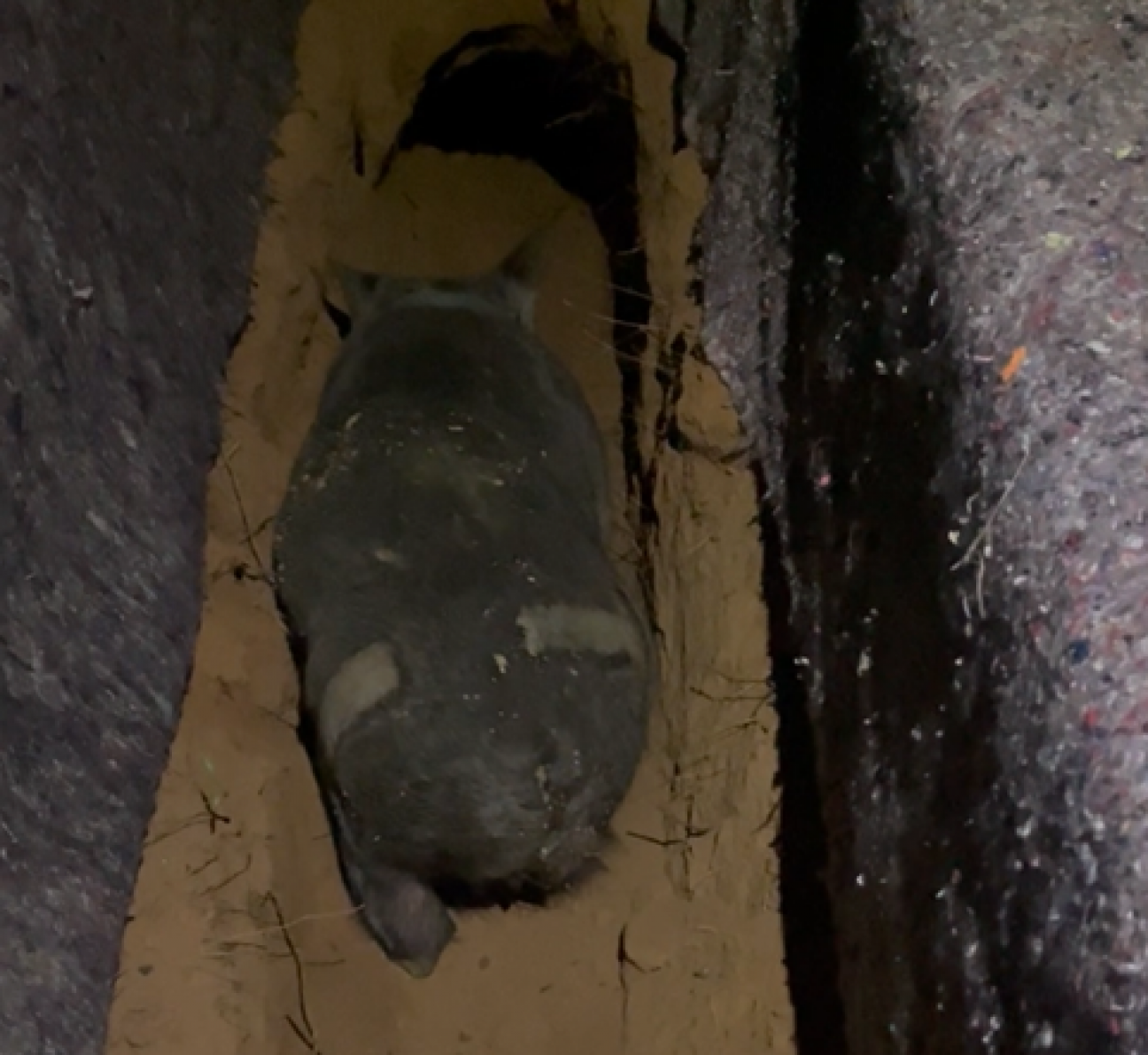
Candid camera – a northern hairy-nosed wombat is shown being released into a new burrow at Powrunna State Forest. Check out that haircut!
Follow-ups – monitoring the wombats
We want to keep on top of the translocated wombats’ progress, so several forms of continuous monitoring have been put in place. Initial monitoring has been focused on the GPS transmitters of individuals to track how they’re adjusting to their new home. There are also cameras set up around the site and at burrows to keep an eye on wombat activity – and the new residents are easily identifiable thanks to the distinct shaved patterns they’ve been given!
Longer-term monitoring will include genetic surveys to describe demographic information and assess population growth and diversity compared to the population at Epping.
By the numbers: the success of the project so far
As of August 2025, there have been four successful translocations of northern hairy-nosed wombats from Epping to Powrunna State Forest. The most recent translocation happened in June 2025, with 11 more wombats – six females and five males – making the journey. This brought the total number of residents at the new site to 37, with a healthy balance of 21 females and 16 males.
Why is the northern hairy-nosed wombat threatened?
Like most vulnerable species, there are a number of threats to northern hairy-nosed wombats. The main reasons behind their critically endangered status are believed to be:
- habitat loss
- small population size
- wildfire
- predation
- wildfire
- competition for resources
- drought.
As you can see, these animals have their fair share of challenges – but there is plenty to be hopeful about. Fortunately, appropriate management, research and recovery initiatives are helping us address all threats in our control.

Behind the scenes – two threatened species officers remove a wombat from a trap
What’s being done to help with wombat conservation in Queensland?
As well as the special operations we’ve outlined, there is a broader plan for northern hairy-nosed wombat conservation in Queensland.
The Northern Hairy-Nosed Wombat Recovery Action Plan is a comprehensive strategy addressing the root causes of the species’ critically endangered status. The plan has four key goals:
- Keeping established sub-populations (like the ones at Epping and Powrunna State Forest) maintained at sustainable levels, as well as maximising genetic diversity.
- Secure more support and long-term resourcing for northern hairy-nosed wombat conservation and recovery.
- Creating new wild sub-populations of wombats that can support at least 250 individuals.
- Undergoing more research to inform wombat management and fill any knowledge gaps.
The Queensland Government’s monitoring and management page also outlines all the wonderful work that the Department of the Environment, Tourism, Science and Innovation is doing in the NHW conservation space. You can learn how the department is addressing threats to the northern hairy-nosed wombat, from weed and predator control to burrow monitoring.
Newsletter
Get involved and stay informed with our handpicked environmental news, tips, and stories sent directly to your inbox.